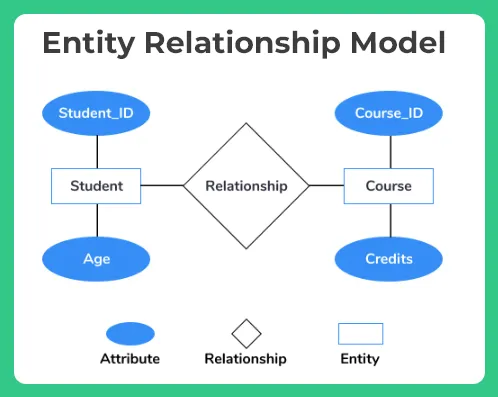
Demystifying the ER Model: Entities, Attributes, and Relationships
As we explore the world of data management, the Entity-Relationship Model (ER Model) emerges as a powerful tool for designing well-organized and efficient databases. But what exactly makes up an ER Model? Let’s break it down into its key components:
1. Entities:
Imagine the building blocks of your database. Entities represent real-world things or concepts you want to store information about. These can be tangible objects (products, cars) or intangible concepts (customers, orders). Think of them as categories of data you want to manage.
In an ER Model, entities are typically depicted as rectangles. Here are some examples of entities in a database for an online store:
- Customer
- Product
- Order
2. Attributes:
Entities are further defined by their specific characteristics or properties. These are called attributes, and they provide the details about each entity. Imagine attributes as the individual pieces of information that describe an entity.
Attributes are shown within the entity rectangles in an ER Model. Here are some examples of attributes for the “Customer” entity:
- Customer Name
- Email Address
- Shipping Address
- Phone Number
3. Relationships:
The real power of an ER Model comes from defining how these entities connect with each other. Relationships represent the associations that exist between different entities. Imagine the connections between people in a social network – an ER Model allows you to depict similar connections within your data.
There are three main types of relationships in an ER Model, represented by lines connecting the entities:
-
One-to-One (1:1): A less common relationship where a single record in one entity corresponds to exactly one record in another entity. For example, a “User ID” entity might be linked to a “User Profile” entity, ensuring each user has a unique profile.
-
One-to-Many (1:M): This is the most common type of relationship. A single record in one entity can be linked to multiple records in another entity. Think of a “Customers” table linked to an “Orders” table. One customer can have many orders, but each order belongs to a single customer.
-
Many-to-Many (M:M): This relationship involves multiple records in one entity being linked to multiple records in another entity. Imagine a “Products” table and a “Categories” table. A product can belong to multiple categories (e.g., clothing, sportswear), and a category can have many products. To establish this relationship, a separate table is often used, called a junction table, which holds the connections between the two main tables.
Benefits of Understanding ER Model Components:
By understanding entities, attributes, and relationships, you can:
- Design well-organized databases: A clear ER Model helps you structure your database efficiently, avoiding redundancy and ensuring smooth data flow.
- Communicate effectively: The visual nature of an ER Model facilitates communication between you and others who need to understand the data structure.
- Identify normalization needs: The ER Model can help you identify potential data redundancy issues early on, allowing you to apply normalization techniques for optimal data management.
Here’s what you’ll gain from this lesson:
- A solid understanding of the core components of an ER Model (entities, attributes, relationships).
- The ability to identify and define entities, attributes, and relationships for different data scenarios.
- The foundation for using ER Models to design efficient and maintainable databases.
Remember: The ER Model is a roadmap for your database. By understanding its components, you’ll be well on your way to building strong data structures that can be effectively manipulated with SQL!
Bonus Tip: Throughout the course, we’ll use real-world examples to practice creating ER models for various scenarios. We’ll also explore how these models translate into actual database tables ready for SQL queries!