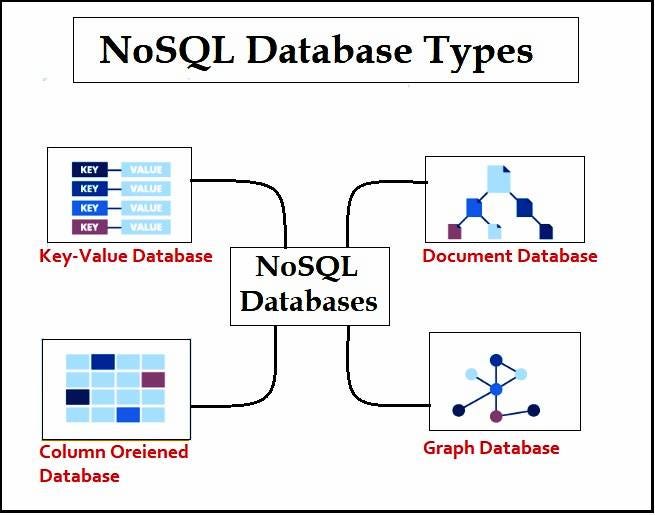
Diving Deeper: Exploring Different Types of NoSQL Databases
In the previous lesson, you discovered the exciting world of NoSQL databases – a realm beyond the structured tables of relational databases. NoSQL offers a variety of data models, each suited for specific data storage and retrieval needs. Imagine a toolbox filled with various tools – NoSQL provides different tools (data models) to handle diverse data types. This lesson delves into the most common NoSQL data models to equip you for selecting the right tool for the job.
Common Types of NoSQL Databases:
- Document Stores:
- Concept: Document stores hold data in JSON-like documents, offering flexibility for storing a variety of data structures within a single document. Think of a folder in your filing cabinet – it can hold various documents (emails, invoices, etc.) with different formats.
- Strengths:
- Ideal for storing semi-structured or unstructured data with varying schemas (like product information with details that might differ from product to product).
- Efficient for storing and retrieving complex data objects that would be cumbersome in relational tables.
- Often provide built-in functionality for querying and indexing documents based on specific fields.
- Examples: MongoDB, Couchbase, Amazon DocumentDB
- Key-Value Stores:
- Concept: Key-value stores are the simplest type of NoSQL database. They store data as key-value pairs, similar to a dictionary. Imagine a keycard and the door it unlocks – the key (unique identifier) grants access to the value (the room).
- Strengths:
- Extremely fast data retrieval based on unique keys, making them ideal for scenarios requiring quick lookups (like user profiles based on user IDs).
- Highly scalable – you can easily add more servers to handle growing data volumes.
- Simple data model, making them easy to understand and use for specific applications.
- Examples: Redis, Memcached, Amazon DynamoDB
- Wide-Column Stores:
- Concept: Wide-column stores resemble tables, but with columns that can vary in structure across rows. Imagine a spreadsheet where each row represents data for a specific entity, but columns can be added or removed as needed.
- Strengths:
- Well-suited for storing large datasets with constantly evolving data structures (like sensor readings or time-series data).
- Efficient for querying data based on specific columns or time ranges.
- Often offer good scalability for handling massive data volumes.
- Examples: Cassandra, HBase, Amazon Keyspaces
- Graph Databases:
- Concept: Graph databases store data as nodes (entities) and edges (relationships) connecting those nodes. Imagine a social network – people (nodes) are connected by friendships (edges).
- Strengths:
- Ideal for modeling complex relationships between data entities (like relationships between products, users, or social connections).
- Efficient for performing queries that traverse these relationships (e.g., finding all friends of a friend).
- Well-suited for applications where understanding connections between data points is crucial.
- Examples: Neo4j, OrientDB, Amazon Neptune
Choosing the Right NoSQL Database:
The best NoSQL database for your project depends on your specific data storage and retrieval needs. Here’s a quick guide:
- For large, unstructured, or diverse data: Document stores or wide-column stores are good choices.
- For high-speed lookups based on unique keys: Key-value stores excel in this area.
- For modeling complex data relationships: Graph databases are your go-to option.
Here’s what you’ll gain from this lesson:
- Gain a deeper understanding of the four main types of NoSQL databases: document stores, key-value stores, wide-column stores, and graph databases.
- Learn about the strengths and ideal use cases for each type of NoSQL database.
- Develop the ability to choose the most suitable NoSQL data model for your data storage requirements.
Remember: NoSQL databases offer a versatile toolkit for handling diverse data. Understanding the different data models empowers you to make informed decisions when selecting the best NoSQL solution for your project.
Bonus Tip: Throughout the course, we’ll explore real-world scenarios where each type of NoSQL database shines. We’ll compare and contrast different NoSQL models with hands-on examples to solidify your understanding. Get ready to become a NoSQL data model pro!